The Courage to Be Disliked
Ichiro Kishimi and Fumitake Koga
Book · B0004
The Courage to Be Disliked
Ichiro Kishimi and Fumitake Koga
Use Adlerian psychology to see through the chains of social approval and reclaim what is truly your own life task.
13
routes
8
work examples
AI
AI prompts
What can this book help you build?
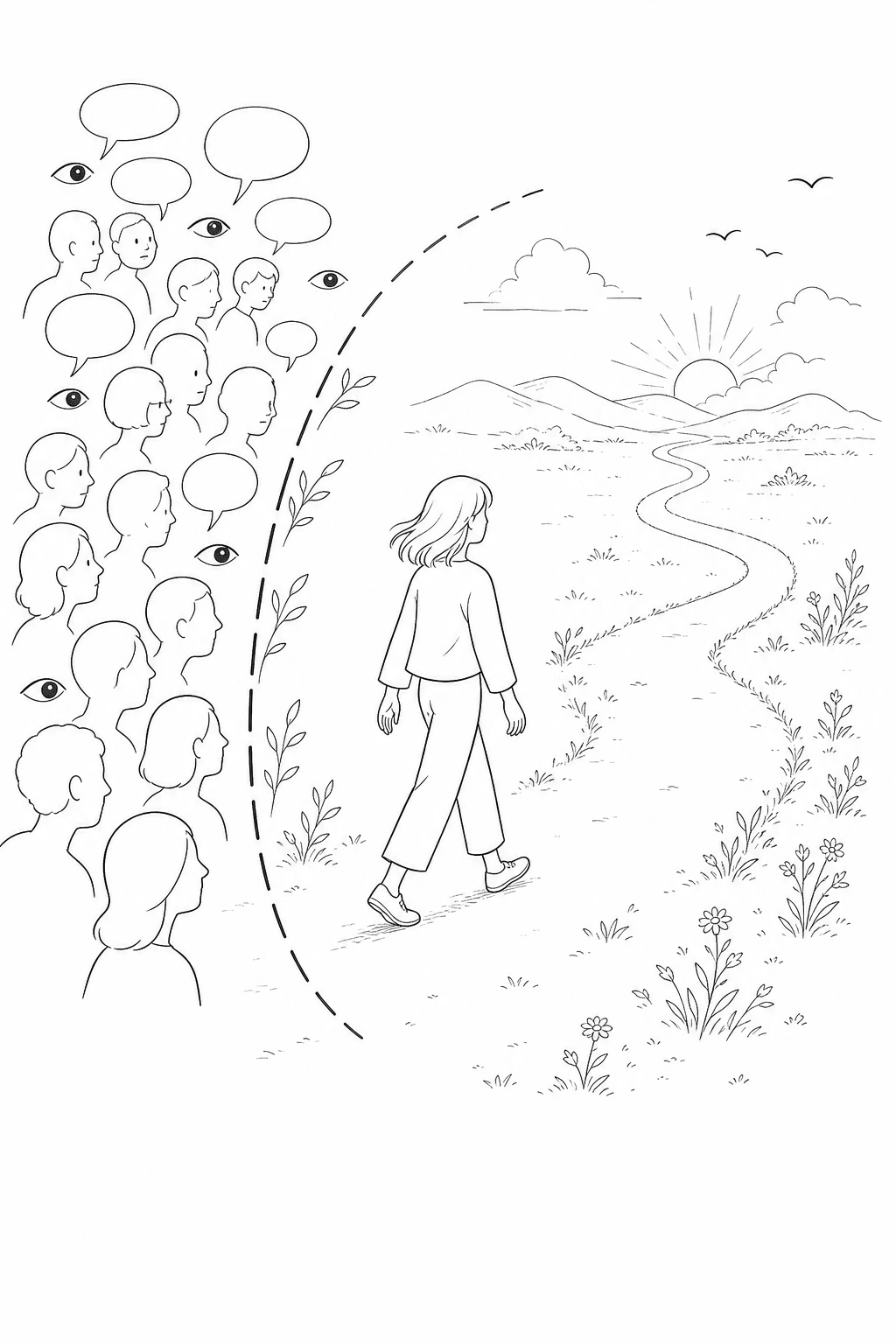
This book unfolds as a dialogue between a philosopher and a young man, revealing the core claim of Adlerian psychology: your behavior is not a product of past "causes" but a choice aimed at future "purposes." It doesn't lecture you on theory — it helps you see a concrete struggle: why you constantly care what others think, why you fear being rejected, why you can't help feeling jealous of certain people, and whose task it really is. Inside the island, the book transforms into a "task-separation map," a "self-portrait," a "horizontal-relationship communication script," a "validation-free decision tool," and an ongoing growth archive tracking your real changes. Every route isn't about writing down feelings — it's about using the book's tools to create something you can actually put to work in your everyday life.
Best for
- ✓You've long been sensitive to other people's opinions and tend to drain yourself over how they react
- ✓You feel compelled to satisfy parents, partners, or supervisors and find it hard to say no
- ✓You hold yourself to harsh perfectionist standards and are afraid of failure
- ✓You often fall into jealousy or comparison with others in your relationships
- ✓You want to build more equal relationships at work or at home
- ✓You feel like your life is driven by "other people's expectations" rather than your own choices
Problems this book can help you solve
- !I'm always terrified of disappointing others — what can I do about that?
- !I know I shouldn't care, but I can't stop obsessing over what people think of me.
- !After fighting with my parents, I don't know how to set boundaries without losing the relationship.
- !I feel jealous when a coworker gets promoted, and then I feel ashamed for feeling that way — how do I handle this?
- !I've been trying to please my manager for so long that I no longer know what I actually want.
- !I keep procrastinating — I always know what I need to do, but I can never bring myself to start.
- !When I talk with my partner, I keep falling into the "you don't care about me" blame cycle.
- !I find it almost impossible to turn down requests because I'm always worried about upsetting people.
- !I want to change, but I keep telling myself "this is just who I am" — it feels hopeless.
- !Whenever I face an important decision, I'm paralyzed — I don't know whether to trust myself or listen to everyone else.
What do you want to take away?
Generate My 'People-Pleasing' Self-Portrait
You'll look back at three to five real choices you made in the past three months out of fear of rejection or desire for approval, analyze each one through Adler's teleological lens (the purpose behind behavior) and the principle of 'not seeking others' approval,' identify your three to five most recurring inner-conflict patterns, and produce a self-portrait answering 'Why do I always try to please others?'
Design a 'From Envy to Horizontal Recognition' Transformation Plan
You'll choose a real interpersonal friction point — one that makes you feel envious, emotionally drained, or unable to let go — and use the 'vertical vs. horizontal relationships' and 'separation of tasks' principles from *The Courage to Be Disliked* to analyze the psychological purpose behind the situation. Then you'll design an actionable plan to convert vertical competition into horizontal recognition.
Create a 'Task Separation' Decision Card
You'll choose a real interpersonal decision you've been wrestling with — one where you keep seeking others' approval before moving forward — and use the book's 'Three Questions of Task Separation,' community-feeling judgment, and horizontal-relationship self-check to clarify 'whose task this really is, what you can control, and how you should respond.' You'll end up with a decision card you can pull out instantly the next time a similar situation arises.
Rewrite a Real Conversation Without People-Pleasing or Blaming
You'll choose a real conversation that has drained you — one where you said something you regretted, or words you never got to say — with a parent, partner, boss, or friend. Using the book's principles of *horizontal relationships* and *separation of tasks*, you'll first diagnose the problems in the original exchange, then rewrite it into a new script that is honest, respectful, and clear — without people-pleasing or blaming. Finally, you'll record what it feels like to practice saying the rewritten version aloud.
Explain 'Task Separation' and 'Horizontal Relationships' in 10 Minutes
You'll create a teaching material that can be delivered as a 10-minute talk to someone who has never read this book — using a five-part structure: an opening hook, teleological reversal, the three-question task-separation exercise, a horizontal-relationship practice, and a tonight-ready tool — so that your audience walks away able to apply the core ideas from *The Courage to Be Disliked* in one real situation immediately.
Build a Long-Term Growth Archive Through an Adlerian Lens
Using Adlerian psychology as your framework, you\'ll document — over six months or more — moments of task separation, progress in self-acceptance, horizontal-relationship practice, and small acts of the courage to be disliked. Each month you complete a four-question review, each quarter you update behavioral patterns, and every six months you capture the evolution of your personal principles, ultimately assembling a genuine, revisable growth archive.
Works you can take away from this book
《My Task-Separation Map》
Apply the task-separation principle to map out the three relationships that have drained you the most over the past three months, clearly marking which tasks are yours and which belong to someone else.
Make my own《My People-Pleaser Self-Portrait》
Use teleology and horizontal-relationship analysis to produce an honest portrait of why you keep trying to please others — and pinpoint the specific purpose driving that behavior.
Make my own《My Script for Saying No to My Parents》
Pick one real scenario and rewrite a conversation with a parent (or partner) using horizontal-relationship principles — practice expressing your true feelings without blaming or appeasing.
Make my own《My Validation-Free Decision Matrix》
Face a real decision that has stalled because you're waiting for someone's approval, and use the book's tools to build a decision matrix that brings you back to "what is my task right now."
Make my own《Explaining The Courage to Be Disliked to a Colleague》
In 10 minutes, explain task separation and horizontal relationships clearly enough that a colleague or friend can immediately apply them to one specific situation in their own life.
Make my own《My "Right Now" Growth Archive》
Start from one specific event that has been draining you, document how you reinterpret it through the lens of teleology, and track your actions and reflections over the next thirty days.
Make my own《My Jealousy Map and Rivalry Alternative》
Break down one relationship that triggers jealousy or exhaustion — identify whether it's rooted in vertical competition or the need for horizontal approval — then design a concrete plan for shifting toward an equal relationship.
Make my own《One Person, One Task: A 30-Day Action Challenge》
Choose one thing you've been putting off because you fear others' judgment, then start it and document your real experience across 30 days.
Make my own