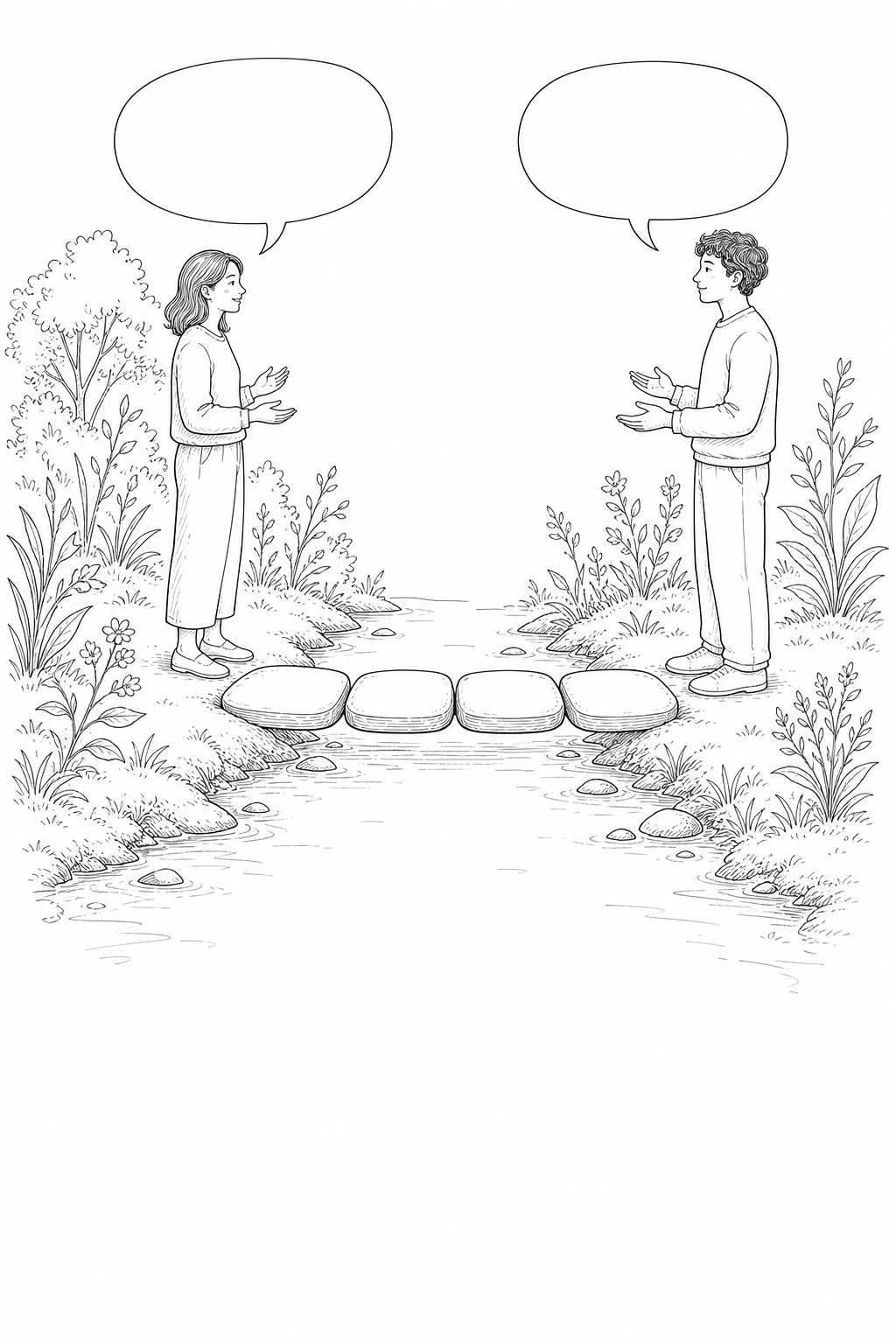
Nonviolent Communication: A Language of Life
Marshall Rosenberg
Book · B0007
Nonviolent Communication: A Language of Life
Marshall Rosenberg
Use the four-step Observe–Feel–Need–Request process to turn conflict into genuine connection.
13
routes
8
work examples
AI
AI prompts
What can this book help you build?
This book isn't an etiquette guide on how to "speak nicely" — it helps you see clearly how the language we habitually use — judgment, blame, comparison — quietly cuts us off from the people we care about. Marshall Rosenberg uses the metaphor of giraffe language versus jackal language to illuminate the four core elements of NVC: observation (describing facts without evaluation), feelings (identifying emotions rather than interpretations), needs (discovering the real needs behind your feelings), and requests (making specific, doable asks). Once you enter the Shufang Island, these elements can be transformed into parent-child conflict rewrite scripts, a family emotional traffic light, an NVC co-reading activity, and an AI-powered communication coaching toolkit. Every route starts from a real communication struggle you've faced and ends with a piece of work you can put to use in your very next conversation.
Best for
- ✓People who often regret what they said after an argument
- ✓Parents who want to improve communication with their children and reduce pushback
- ✓People who don't know how to give workplace feedback without hurting relationships
- ✓People who feel their emotions and needs are consistently overlooked
- ✓People who want their partner or family members to truly listen to them
- ✓People who want to teach this method to their team or household
Problems this book can help you solve
- !My child bursts into tears or fights back whenever I criticize them — what should I say next time?
- !Every time my partner and I discuss something, it escalates into a fight — how do I pump the brakes?
- !A colleague made a mistake and I want to point it out without damaging our relationship — how do I bring it up?
- !I'm clearly hurt, but when I say so, the other person hears it as "you're blaming me" — why does that happen?
- !I want to say no to someone's request without seeming selfish — how do I phrase it?
- !My child refuses to do homework no matter what I say — where is the real problem?
- !When I raise a point in meetings, people respond defensively instead of really listening — how do I change that?
- !I feel deep anger toward someone, but I don't know what need is underneath that anger.
- !I want to give a friend feedback but I'm afraid of damaging the relationship, so I've kept quiet — what should I do?
- !Conversations with my parents always circle back to the same deadlock — where is the way out?
What do you want to take away?
Rewrite a Parent-Child Conflict as an NVC Script
You'll choose a real or highly typical parent-child conflict dialogue, rewrite every line from jackal language into giraffe language, annotate the NVC element behind each revision, and produce a ready-to-use conversation script for the next time conflict arises.
Build My Needs Portrait
You'll use the book's emotion-needs inventory to map the core needs most often overlooked in three areas of your life — family, work, and intimate relationships — and create your own needs checklist and emotional trigger map.
Design a Workplace Feedback NVC Plan
You'll choose a real workplace feedback challenge and use the four NVC components to design a judgment-free feedback plan that the other person can actually hear — covering what to say, how to say it, and a risk check.
Explain NVC in 10 Minutes
You'll choose a real audience (family member, colleague, or book club) and organize the four NVC components, the giraffe/jackal metaphor, and one real-life case into a structured 10-minute talk script — so your listeners walk away with one phrase they can use that same day.
Design a Family NVC Role-Play Co-Reading Activity
You'll design a 1.5–2 hr family co-reading activity that includes a warm-up icebreaker, role-play practice, a KPT retrospective, and drafting a family communication pledge — letting everyone experience 'giraffe language' firsthand rather than just hearing theory.
Build a Personal NVC Communication AI Coaching Toolkit
You'll create one ready-to-use AI prompt template for each of 3–5 high-frequency conflict scenarios, letting AI "translate" what you say in the heat of the moment into NVC expressions — or guide you through post-conflict reflection step by step — forming a personal NVC toolkit you can call on anytime.
Works you can take away from this book
《Parent-Child Conflict NVC Rewrite Script》
Take a real parent-child conversation and rewrite it from jackal language into giraffe language, paired with scenario cards.
Make my own《My Needs Inventory》
Use the NVC feelings-and-needs mapping table to identify the 5 core needs that matter most to you in family, work, and relationships.
Make my own《Family Emotional Traffic Light》
Create a red-yellow-green three-level emotional check card so your family knows when it's safe to keep talking and when it's time to pause.
Make my own《NVC in 10 Minutes》
A structured explanation script for introducing the four elements of Nonviolent Communication to family members or colleagues.
Make my own《NVC Co-Reading Activity Plan》
Design a co-reading session where family members genuinely participate in role-play — not just share impressions.
Make my own《AI Communication Scenario Coaching Toolkit》
Build a set of AI prompts that simulate real conflict scenarios so you can practice NVC responses anytime.
Make my own《Workplace Feedback NVC Plan》
Design an NVC approach for a real workplace feedback challenge — covering what to say, how to say it, and common pitfalls to avoid.
Make my own《My NVC Growth Journal》
Document real conversations you handled with NVC over 4 weeks, and reflect on the patterns and insights you discover.
Make my own