Thinking, Fast and Slow
Daniel Kahneman
Book · B0010
Thinking, Fast and Slow
Daniel Kahneman
See the two systems in your own mind — and use slow thinking to protect your high-stakes decisions.
13
routes
6
work examples
AI
AI prompts
What can this book help you build?
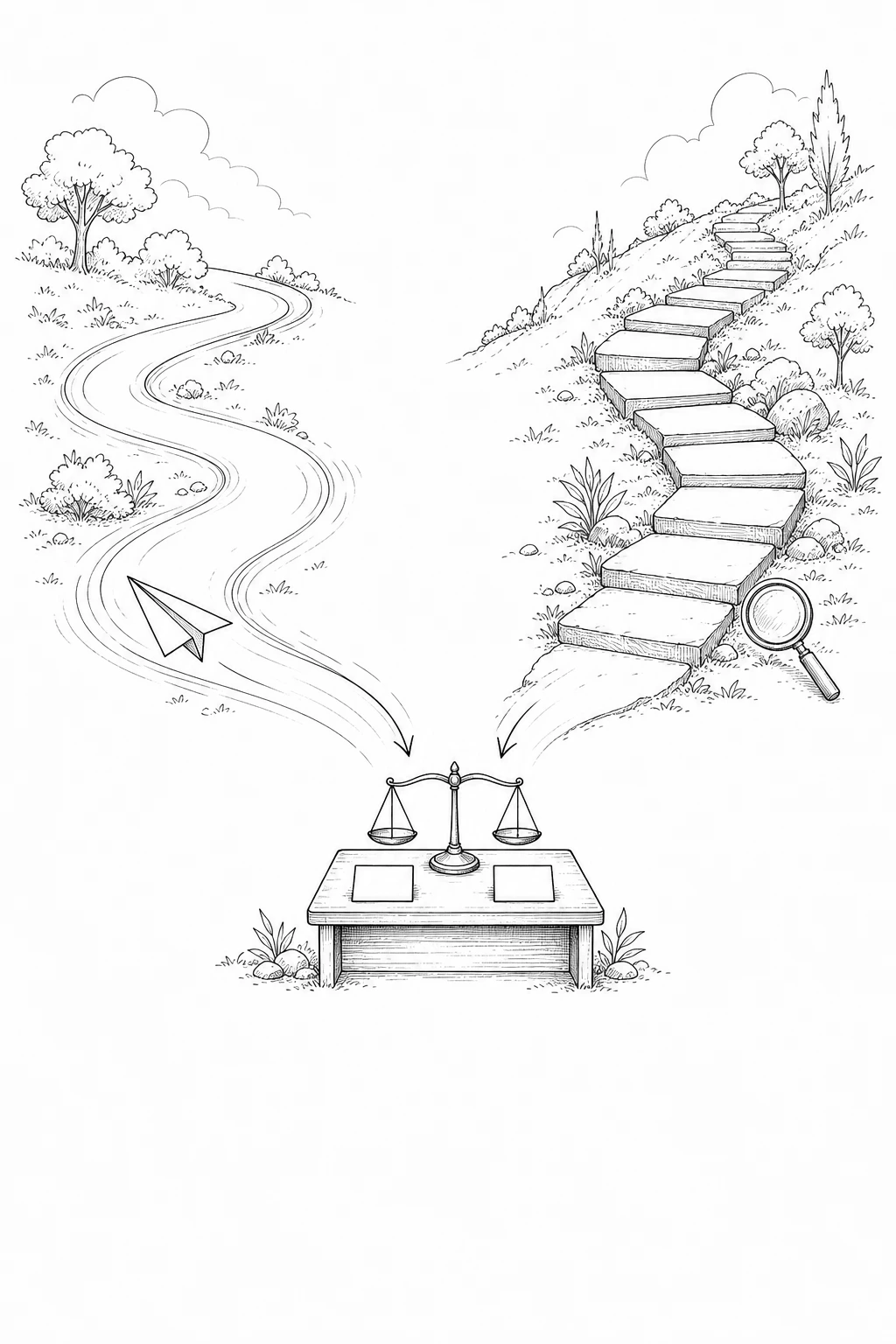
This book isn't abstract advice about being rational — it's a mirror that shows you exactly how your thinking goes wrong. Through behavioral economics experiments, Kahneman maps out the partnership and conflict between System 1 (fast, automatic, intuitive) and System 2 (slow, effortful, logical). The gut-feel decisions you make in spending, investing, hiring, and negotiating are quietly distorted by anchoring effects, availability bias, loss aversion, and framing effects. On Shufang Island, this book transforms into a cognitive-bias self-portrait, a personal decision checklist, scenario rewriting scripts, and an AI slow-thinking toolkit. Every route is built around your own real decision moments — not analyzing others, but seeing yourself clearly.
Best for
- ✓People who want to build a check-in habit before making important decisions
- ✓People who find themselves swayed by discounts, deadlines, and comparison anchors when shopping
- ✓People who have made high-stakes decisions — investing, starting a business, job hunting — and want to reflect on them
- ✓People who evaluate others (hiring, performance reviews, assessments) and want to reduce judgment bias
- ✓People who feel unsure whether their own intuition can be trusted
- ✓People who want to explain behavioral economics concepts to others
Problems this book can help you solve
- !I know I should be rational, but I still follow my gut when making decisions — how do I change that?
- !I always get anchored by the first price I see and only realize later that I overpaid — how do I catch that?
- !I often "refuse to admit a loss" in investing or major decisions — why does that happen?
- !I tend to be swayed by first impressions when interviewing candidates — how do I make my evaluations more objective?
- !Why does my judgment change when the same information is framed differently?
- !I tend to over-worry about rare risks but ignore common ones — how do I recalibrate?
- !Why does a bad ending ruin my whole memory of an experience?
- !I want to teach my kids or friends about cognitive biases — how do I make these concepts engaging and practical?
- !I want to check whether a major decision I made was distorted by bias — where do I start?
- !I want to build a personal decision tool that helps me 'slow down' — how do I do that?
What do you want to take away?
Create Your Cognitive Bias Self-Portrait
You'll review 3–5 real decisions from the past three months that felt 'off' in hindsight, identify the high-frequency biases behind each using the System 1 vs System 2 framework, and ultimately draw a 'Thinking Error Pattern Checklist' that's uniquely yours.
Create a Personal Decision Checklist to Trigger Slow Thinking
You'll pick 1–2 high-risk scenarios where you tend to make poor decisions, then use loss aversion, framing effects, anchoring bias, availability bias, and overconfidence from *Thinking, Fast and Slow* to design a '5-Step Pre-Decision Checklist' that forces System 2 to kick in at your most error-prone moments.
Design a Bias-Free Evaluation Process
You'll pick a real organizational evaluation scenario (job interviews, promotion reviews, vendor selection, student admissions, etc.) and use the halo effect, anchoring bias, and Meehl's statistical prediction principles from *Thinking, Fast and Slow* to design a structured evaluation process and scoring form that reduces intuitive misjudgment.
Write a Field Report on Anchoring in Real-World Pricing
You'll pick 5 real-world anchoring cases (mall original-price strikethroughs, e-commerce thresholds, restaurant menu design, real estate listing prices, job salary expectations, etc.), collect evidence, strip the anchor, measure the shift, and write a field report on how anchoring happens, how to spot it, and how to fight it.
Explain System 1 and System 2 in 10 Minutes
You'll turn the core framework of *Thinking, Fast and Slow*—the division, conflict, and typical biases of System 1 and System 2—into a mini-lesson that can be delivered in 10 minutes, including 2 interactive experiments and 4 high-frequency bias examples, ready to share with your team, students, clients, or family.
Build a 'System 2 Agent' AI Toolkit
You'll design an AI prompt toolkit based on 5–8 core biases from *Thinking, Fast and Slow* (anchoring, availability, loss aversion, framing, overconfidence, etc.), so the AI acts as a 'slow thinking trigger' that questions your intuitive judgments when you make important decisions.
Works you can take away from this book
《My Cognitive Bias Self-Portrait》
Use the System 1 vs System 2 framework to identify the specific bias types behind three of your own typical decision mistakes.
Make my own《The Slow-Thinking Checklist for Spending Decisions》
Design a System 2 trigger checklist for three types of purchases — big-ticket items, courses, and investments — to avoid being led astray by anchoring effects and loss aversion.
Make my own《Anchoring Effect Research Report》
Collect five real price-comparison examples, then analyze how anchoring effects operate in spending and negotiation contexts.
Make my own《A Debiasing Plan for Hiring Evaluations》
Analyze the availability bias and halo effects that may have appeared in one of your past interview judgments, then design a structured evaluation rubric.
Make my own《Explain System 1 and System 2 in 10 Minutes》
Transform Kahneman's core framework into a concrete, example-driven mini-lesson you can deliver in under 10 minutes.
Make my own《AI Slow-Thinking Assistant Toolkit》
Use the bias checklist from the book to build a set of AI prompts that act as your 'System 2 proxy' — prompting you with challenging questions whenever you are about to make an important judgment call.
Make my own